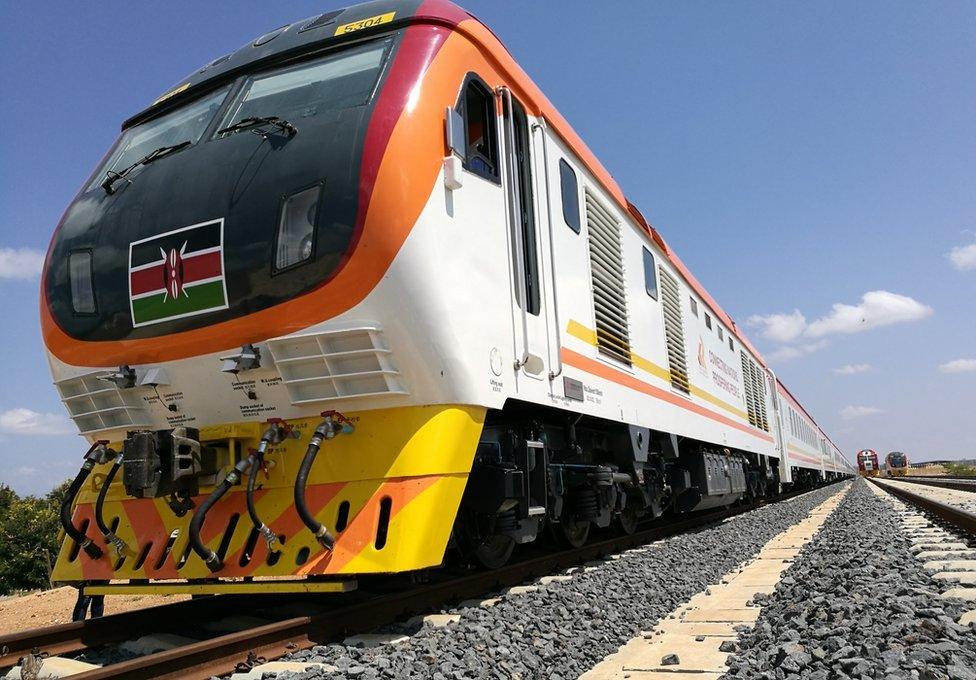
Do you know the Madaraka Express story? Every afternoon at the Nairobi Terminus in Syokimau, a quiet transformation unfolds. The ambient hum of heavy engines vibrates through the polished concourse while hundreds of travelers are balancing woven baskets, wildlife photographers double-checking their lens mounts, and coast-bound tourists clutching paper boarding passes with files through the departure gates.
Outside on the platform sits the Madaraka Express: a sleek, diesel-electric locomotive whose red, white, and black livery mirrors the colors of the Kenyan flag. The modern train operating on Kenya’s Standard Gauge Railway line.
When the conductor’s horn echoes across the Kapiti Plains, the train glides forward with a stillness that feels almost surreal to anyone who has ever endured the chaotic, diesel-fumed slog of the old highway. In less than five hours, this single line of steel will slice through the heart of the Great Rift Valley’s foothills, bisect the ancient, sun-baked bushland of Tsavo, and deposit its passengers within sight of the swaying coconut palms of the Indian Ocean.
The story of the locomotive is more than a narrative of modern transit. It is a tale of shifting geopolitics, monumental engineering, environmental compromises, and a nation actively rewriting its relationship with time and space.
How Did the Railway Begin?
To understand why the Madaraka Express feels like a national landmark, one must first look back at the iron ghost it replaced. For over a century, overland travel between Kenya’s coast and its interior was dictated by the historic Uganda Railway. Built by the British Empire between 1896 and 1901, that original meter-gauge track was notoriously dubbed the “Lunatic Express” due to its staggering financial cost, immense logistical peril, and tragic loss of human life.
By the early 2000s, however, the old line was falling apart. What was once a marvel of Victorian engineering had decayed into an agonizingly slow, breakdown-prone relic. Freight trains took days to move goods from the Port of Mombasa to Nairobi, while passenger travel on the old line was an exercise in extreme patience, often marred by derailments, power failures, and delays that stretched long into the night. The economic pulse of East Africa was choking on an infrastructure bottleneck.
The turn of the millennium brought a decisive shift in Kenya’s development strategy. Recognizing that economic expansion required a modern transport backbone, the government envisioned the Standard Gauge Railway (SGR) project. The plan was breathtaking in scale: build a brand-new, world-class railway corridor that could move heavy freight and high-speed passenger trains across the country with unprecedented efficiency.
The project officially took off through a major partnership between Kenya and China. The China Road and Bridge Corporation (CRBC) was contracted to build the line, backed by a monumental funding package of roughly 3.2 billion for Phase 1, primarily financed through commercial and concessional loans from the Exim Bank of China.
Construction began in 2014, transforming the country into an engineering landscape unlike anything seen since colonial times. Thousands of Kenyan workers joined Chinese engineers to clear rights-of-way, lay tracks, and construct soaring bridges. The engineering team faced extraordinary obstacles:
- Topographical Diversity: The track had to descend smoothly from the high-altitude urban plateau of Nairobi down to the sea-level coastal plains of Mombasa without exceeding safe gradient limits for heavy freight trains.
- Volcanic and Unstable Soils: Crossing regions with shifting clay soils and ancient volcanic activity required extensive land stabilization and specialized ballasting techniques.
- Ecosystem Protection: Perhaps the most sensitive challenge was navigating the delicate ecosystems of Tsavo East and Tsavo West National Parks. Designers created kilometers of elevated superstructures, massive viaducts, and dedicated animal underpasses so that elephants, giraffes, and big cats could migrate underneath the tracks without risking fatal collisions with passing trains.
On June 1, 2017, a national holiday known as Madaraka Day, commemorating Kenya’s achievement of self-rule in 1963, the Madaraka Express made its maiden journey. The ceremony was met with immense national pride. For the first time in history, a journey that once took an exhausting 10 to 12 hours by bus or car was cut down to a smooth, predictable four and a half hours.
In October 2019, the vision expanded further with the completion of Phase 2A. This extension pushed the SGR line northwest from Nairobi, carving a spectacular path through the volcanic landscapes of the Great Rift Valley before terminating at Suswa.
What Goes on at the Madaraka Express Today?

Step into either of the main termini. Nairobi Terminus in Syokimau or Mombasa Terminus in Miritini—and the atmosphere is undeniably modern. The architecture of these flagship stations reflects local heritage blended with modern industrial design; the Nairobi station is shaped to evoke two locomotives meeting, while the Mombasa station pays homage to traditional coastal ripples and marine motifs.
Today, the Madaraka Express is the beating heart of domestic transit in Kenya, carrying millions of passengers annually. The system runs with a level of strict punctuality that has fundamentally changed how Kenyans plan their travel.
Daily Operations and Passenger Classes
Kenya Railways operates two distinct types of passenger services along the Nairobi-Mombasa corridor:
- The Express Train: Built for speed, this direct service runs non-stop between Nairobi and Mombasa (or with a single brief technical stop), making the 472-kilometer trip in roughly 4.5 to 5 hours. It is the preferred choice for business travelers, weekend vacationers, and tourists seeking a swift journey.
- The Inter-County Train: Acting as a vital local lifeline, this train stops at key intermediate stations—including Athi River, Emali, Kibwezi, Mtito Andei, and Voi. It connects smaller agricultural, mining, and regional hubs to the major cities, allowing residents to move goods and travel affordably.
Inside the Madaraka Express, passengers can choose from three distinct travel experiences:
- Economy Class: Bright, air-conditioned, and organized in a 3×2 seating arrangement, Economy Class offers an affordable, lively atmosphere. Large windows give every row a view of the passing countryside, and onboard attendants serve cold drinks and light snacks throughout the trip.
- First Class: Offering more personal room, First Class features wide, plush reclining seats arranged in a 2×2 layout with fold-down tray tables, individual charging ports, and extra legroom. Passengers also enjoy access to dedicated lounges at the main termini before departure.
- Premium Class: For those seeking top-tier comfort, Premium Class offers exclusive lounge service, personalized onboard attention, gourmet meal options, and ultra-wide, fully adjustable seats designed for maximum relaxation.
The Freight Engine: Unsung Hero of the SGR
While the passenger trains capture the public imagination, the SGR Freight Service is the true economic workhorse of the railway. Heavy freight trains operate around the clock, hauling thousands of shipping containers directly from the berths of the Port of Mombasa to the Inland Container Depots (ICD) in Nairobi and Naivasha.
By shifting millions of tons of cargo off the roads, the SGR has transformed national logistics:
- Highway Safety: It has dramatically reduced the volume of heavy, multi-axle cargo trucks clogging the Mombasa-Nairobi highway, significantly lowering traffic accidents on what was historically one of East Africa’s most dangerous roads.
- Road Maintenance: Highway wear and tear has decreased, saving taxpayers millions in perpetual road repairs.
- Logistical Speed: Cargo that once took days to clear customs and haul overland now arrives at the capital within hours of leaving the port.
Are There Myths and Legends Related to this Railway?
Whenever human engineering carves a path through ancient wilderness, myth and history inevitably intertwine. The route traveled by the Madaraka Express runs directly parallel to lands rich with local lore, dramatic history, and legendary tales.
The Shadows of the Tsavo Man-Eaters
The most famous legend embedded in the soil along the SGR track is the tale of the Man-Eaters of Tsavo. In 1898, during the construction of the original colonial railway, two large, maneless male lions terrorized the construction workers building a bridge over the Tsavo River. For over nine months, these formidable predators stalked the railway camps at night, dragging workers from their tents.
Work on the original line came to a complete standstill as terrified laborers fled the area, convinced the lions were not mere animals, but spirit-demons (mashetani) sent by local guardians to destroy the iron snake invading their land. The ordeal only ended when the chief engineer, Lt. Col. John Henry Patterson, hunted and killed both lions.
Elevated SGR viaduct over Tsavo National Park designed to allow wildlife to cross safely beneath the tracks.
Today, as the modern Madaraka Express glides silently over the soaring, concrete viaducts elevated high above the Tsavo River, passengers look down upon the very same scrubland where those legendary events took place. The contrast between the high-tech train and the raw, untamed wilderness below reminds every traveler of the fierce wildness that once held human progress at bay.
Spirits of the Rift Valley and Sacred Hills
Further inland, as the Phase 2A extension leaves Nairobi and swoops into the Great Rift Valley toward Suswa, the railway passes through regions deeply tied to Maasai and Kamba spiritual heritage.
During the construction of the railway’s deep cuts and tunnels, local elders voiced deep concerns regarding the destruction of prominent rock formations and ancient trees. Local folklore held that certain rocky outcrops along the rift escarpments were sacred dwelling places for ancestral spirits. Rumors circulated in nearby villages that disturbing these geological landmarks would disrupt seasonal rains or bring bad omens to the surrounding communities.
When unseasonal weather patterns and sudden flash floods briefly disrupted construction sites in 2016, local legends flared up anew, attributing the mudslides to the anger of the earth spirits. To build trust, construction crews worked closely with local community leaders, holding traditional blessing ceremonies and adjusting track alignments where possible to respect culturally significant sites.
Nearby Tourist Attractions to the Madaraka Express
One of the greatest gifts of the Madaraka Express is how effortlessly it connects travelers to Kenya’s incredible biodiversity and rich cultural heritage. Rather than enduring a long, exhausting drive, visitors can step off the train and find themselves at the doorstep of world-famous destinations:
1. Nairobi National Park (Nairobi Terminus)
Located mere minutes from the starting platform in Syokimau, Nairobi National Park holds a unique global distinction: it is the only protected wildlife park on Earth directly bordering a major capital city’s skyline.
- What to See: Black rhinoceroses, lions, leopards, cheetahs, zebras, and giraffes roaming open acacia plains with glassy skyscrapers looming in the background.
- The SGR Connection: The railway itself passes directly through the park on a series of towering, sound-dampened elevated pillars, providing a striking visual synthesis of modern infrastructure and wilderness preservation.
2. Tsavo East and Tsavo West National Parks (Mtito Andei & Voi Stations)
Disembarking at intermediate stations like Mtito Andei or Voi brings train travelers straight into the vast expanse of Tsavo—one of the largest natural wildlife sanctuaries on the planet.
- Tsavo East: Famous for its sweeping, dust-red plains, vast herds of “red elephants” (colored by the iron-rich soil they dust themselves with), the Yatta Plateau, and Lugard Falls.
- Tsavo West: Offers a dramatically varied landscape of volcanic cones, lava flows at Shetani, and Mzima Springs—a crystal-clear subterranean oasis where filtered water gushes out of volcanic rock, allowing visitors to view hippos and crocodiles from a submerged glass observation chamber.
3. Mombasa Old Town & Coastal Beaches (Mombasa Terminus)
Arriving at the coastal terminus in Miritini puts travelers a short drive away from the warm waters of the Indian Ocean and centuries of coastal history.
The scenic Kenyan coast at Mombasa, accessible via the coastal terminus of the SGR line.
- Fort Jesus & Old Town: Built by the Portuguese in the late 16th century, Fort Jesus is a UNESCO World Heritage site overlooking the historic harbor. Surrounding the fort is Mombasa Old Town, a maze of narrow alleys, carved Swahili wooden doors, spice markets, and ancient mosques reflecting centuries of Swahili, Arab, Portuguese, and Indian cultural fusion.
- World-Class Beaches: From the northern shores of Nyali, Bamburi, and Shanzu to the legendary south-coast stretches of Diani Beach, travelers can transition from the train car to coral reefs, dhow sailing cruises, and pristine white sand in a matter of hours.
4. Lake Naivasha & Hell’s Gate National Park (Suswa Extension)
For those taking the Phase 2A route into the Great Rift Valley, the journey leads toward one of Kenya’s most dramatic geological playgrounds.
- Lake Naivasha: A high-altitude freshwater lake famous for its dense population of hippos, vibrant birdlife (including fish eagles), and serene boat safaris.
- Hell’s Gate National Park: One of the few national parks where visitors can hike or bicycle alongside giraffes, zebras, and gazelles. Its towering obsidian cliffs, geothermal steam vents, and narrow gorges inspired the iconic landscapes of animated classics like The Lion King.
Key Information for Potential Travelers
For anyone planning to experience this remarkable rail journey firsthand, keeping a few practical tips in mind will ensure a better experience.
- Booking Tickets: Tickets can be purchased online through the official Kenya Railways SGR booking portal, via USSD codes on local mobile networks, or directly at the station ticket counters. Because the service is immensely popular with both locals and tourists, booking several days to weeks in advance, especially around weekends and public holidays, is strongly advised.
- Station Security and Punctuality: Security at all SGR termini is exceptionally thorough. Expect multi-stage bag checks, sniffer dogs, and passport/ID verifications before entering the departure halls. Train departures are famously exact; the train will pull away precisely on the minute scheduled, so arriving at least 60 to 90 minutes prior to departure is essential.
- Luggage Rules: Passengers are allowed generous carry-on luggage limits, but bags must pass through standard X-ray security scanners. Oversized cargo or restricted items should be cleared with station authorities beforehand.
- Wildlife Spotting Tip: If you are traveling between Nairobi and Mombasa, try to secure a window seat. As the train glides through the elevated sections of Tsavo National Park, keep your eyes fixed on the surrounding scrubland and waterholes—it is remarkably common to spot herds of elephants, giraffes, ostriches, and antelopes grazing just meters from the tracks.
Sources & Image Credits
- Kenya Railways SGR Project History & Online Ticketing: Source: Kenya Railways Corporation Official Portal. Kenya Railways Official SGR Portal
- Tsavo Ecosystem & Environmental Mitigation Measures: Source: African Wildlife Foundation. African Wildlife Foundation Corridors Report
- Tsavo Historical Context & Legend: Source: “The Man-Eaters of Tsavo” by Lt. Col. J.H. Patterson / Kenya National Archives.
- (Madaraka Express Train): Source: Kenya Standard Gauge Railway Media Collection.
- (Nairobi Terminus Station): Source: Kenya Railways SGR Gallery Archives.
- (SGR Viaduct in Tsavo): Source: African Wildlife Foundation Infrastructure Photography.
- (Mombasa Coastal Scenery): Source: Kenya Coast Tourism Board Collection.
Views: 11
Leave a Reply