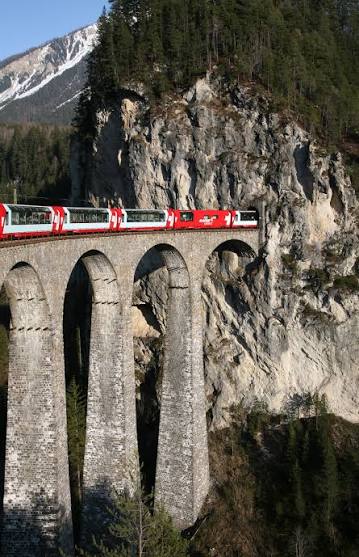
Railways travel is more than a way to move from one place to another. It can be a window into another country’s landscape, history, engineering and culture. Few train journeys demonstrate this better than the Glacier Express, a Celebrated mountain railway linking the resort towns of Zermatt and St.Moritz.
The journey crosses the Swiss Alps, passing through deep valleys, high mountain passes, tunnels and historic villages. It is described as one of the world’s great scenic train experiences because the railway itself is as remarkable as the scenery surrounding it.
How Did the Glacier Express Begin?
The Glacier Express began operating on 25 June 1930. Its purpose was to connect two important Alpine resorts:
- Zermatt in the Canton of Valais, which lies beneath the Matterhorn, one of Europe’s most recognizable mountains.
- St.Moritz in Graubünden, which is famous for winter sports and Alpine Tourism. T
The train therefore joined two destinations that had previously been separated by difficult mountain terrain.
What Goes on at the Railway Today?

Today the official route covers approximately 291 kilometers and takes about eight hours. The journey begins at Zermatt, a village known for its mountain scenery and restricted use of motor vehicles.
From there, the train travels through the Matter Valley towards Brig before continuing into the central Swiss Alps.
One of the most dramatic sections is the ascent towards the Oberalp Pass. At an elevation of about 2,033 metres, the pass is the highest point on the Glacier Express route. The train then descends towards Andermatt, a historic mountain settlement surrounded by steep slopes and high peaks.
What Brings Tourists to this Attraction?
As the train continues eastwards, passengers see a changing landscape.
- Snow-covered mountains may appear beside green meadows, forests and narrow valleys.
- The route also passes through the Rhine Gorge, sometimes called the “Swiss Grand Canyon”.
- Here, the railway follows the young Rhine River through a landscape shaped by erosion and landslides.
- Pale cliffs rise above the track, creating a striking contrast with the river below.
The engineering of the journey is one of its most impressive features.
The Glacier Express crosses 291 bridges and travels through 91 tunnels. These structures were necessary because the railway had to cross steep terrain while maintaining a safe gradient for trains. Instead of taking a direct route up a mountainside, the line sometimes curves, spirals, and crosses itself to gain height gradually.
This design allows passengers to appreciate the landscape while also seeing how railway engineers adapted to the Alps.
Read the Short Ghost Story: The Train to Pasadena
And even as I watched her again, I knew my thoughts and desires were selfish, ego-centric at best. I knew that sooner or later I would have to read her thoughts and solve this mystery, and then all hell would break loose, and I would become death again. Read Now
How the Glacier Express Exposes a Whole New World
A major part of the eastern journey passes along railway lines included in the UNESCO World Heritage Property called the “Rhaetian Railway in the albula/Bernina Landscapes“.
UNESCO explains that the Albula line opened in 1904 and is 67 kilometers long. It includes 42 tunnels and covered galleries, as well as 144 viaducts and bridges. The Bernina line, meanwhile, crosses the mountains through 13 tunnels and galleries and over 52 Viaducts and bridges.
The Landwasser viaduct is among the best-known structures on this section. Built of stone, the curved viaduct carries across a deep valley and leads directly into a mountainside tunnel. Its design combines practical engineering with visual elegance. Rather than appearing separate from the environment, the viaduct seems to belong to the landscape.
This relationship between railway construction and nature is one of the reasons the Albula and Bernina received UNESCO recognition.
The train eventually reaches St.Moritz after passing through places such as
- Church,
- This,
- Tiefencastel,
- Filisur
- and Samedan.
These towns reveal another important role of railway travel: connecting remote communities.
Before modern roads and tunnels made mountain travel easier, railways provided essential links for residents, workers, visitors, and businesses. The lines helped open the Alps to tourism while also supporting everyday life in areas that could otherwise remain isolated during harsh winters.
Conclusion
The Glacier Express is not a high-speed train. Its appeal lies in the opposite experience. Large windows allow travellers to watch the scenery change slowly, while the long journey creates time for observation and reflection.
A passenger can see villages, rivers, glaciers, forests and mountains without the stress of driving on winding roads. The railway turns travel into part of the destination.
The Glacier Express also shows why railway Journeys remain valuable in the modern age. It is a transport service, a historic achievement and a moving viewpoint over one of Europe’s most dramatic regions. From Zermatt to St. Moritz, the route demonstrates how human ingenuity can cross difficult landscapes without overwhelming them.
For travellers who want to understand the connection between engineering, history and nature, this alpine railway offers an unforgettable lesson.
Views: 0
Leave a Reply