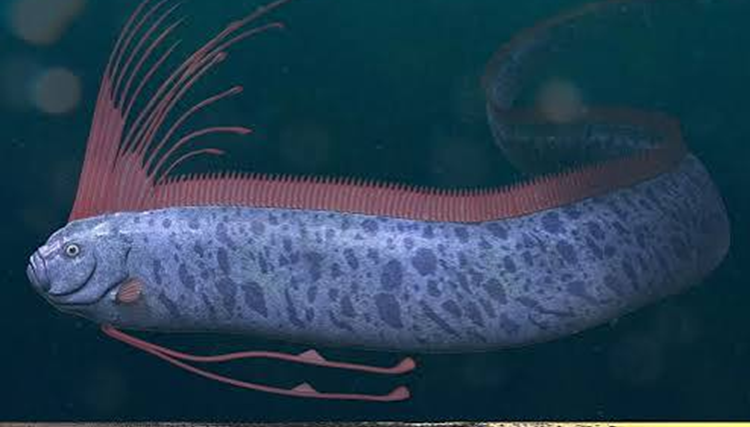
Japanese legends have it that there is a fish that can predict earthquakes and tsunamis. The prophet appears on the water’s surface for several days before the natural phenomenon strikes. Unlike the human prophet Jonah of the Bible, the prophecies of this creature, always come true. Before you laugh out loud or toss this aside, why not let the facts help you decide? Can the oarfish predict natural disasters?
According to the AFK Fact Check, the answer is no. The oarfish cannot predict earthquakes or tsunamis. Extensive scientific research has debunked this persistent belief, classifying the connection as a myth driven by coincidence and confirmation bias
What Is an Oarfish?
It is commonly known as the remo fish, or oarfish. This serpent-like creature has an average length of 8 m (26 ft.) and some sightings have reported remos of up to 17 m (26 ft.). It is scientifically known as the oarfish and lives in moderate temperatures below the seabed (Encyclopedia Britannica, The Oarfish).
Oarfish are the largest known species of bonefish.
History of the Prophet Fish
Japanese fishermen first reported this strange fish during the early first century. The report stated that the fish surfaced for more than three days, close to the shore waters. Shortly afterward a huge tsunami destroyed most of the Japanese Village.
During the winter of 2010, scientists recorded unusual numbers of oarfishes near the Japanese waters. A few months later, the city of Fukushima was devasted by an earthquake and a giant tsunami. The disaster killed over 20,000 people. Needless to say, the media and the people pointed to the appearance of the oarfish, as a prophetic warning.
In June 2023, another remofish was spotted near the coast of Taiwan. The sighting created concern and media buzz about the possibility of an earthquake or Tsunami. A month later the Daily Mail UK published an article indicating the lack of scientific proof that supports this theory.
Scientific Response to Oarfish Warnings

The 2011 tsunami got the scientific world’s attention. Scientists started more studies on these mythical creatures. They are conducting studies to better understand how remo fish work. Animal Planet would not be left behind, and in 2016, included an underwater experience with an oarfish.
The filmmaker Jeremy Wade actually bumped into the animal before swimming alongside the fish for a while (TV episode River Monsters).
Japanese seismologist Kiyoshi Wadatsumi believes that this is very possible. He said:
“deep-sea fish, such as oarfish, live near the bottom of the sea and are highly sensitive to active fault movements.”
More and more scientists are pooling into the possibility that this fish could be an alarm clock for mankind. Scientists have noted that animals seem to have a six-sense ability to detect natural disasters.
Professor of Animal Biology at Anglia Ruskin University Rachel Grant was more specific in her explanation. She said:
“It is theoretically possible because when an earthquake occurs there can be a build-up of pressure in the rocks that can cause electrostatic charges, generating electrically charged ions that will then be transmitted in the water.”
According to both scientists, the remo fish can sense the prelude to an earthquake. This prompts it to leave its natural habitat and seek safer waters. Since earthquakes occur on the seafloor, this brings it to the shore.
The oarfish may not be able to speak our language and explain its weird behavior. Nonetheless, there is obviously some relation between its unusual presence in surface waters and earthquakes. Maybe its all myths and legends, but scientists are delving deeper. Very soon we will know more.
What Other Scientists Say About the Oarfish
1. The Origin of the Myth
- In 2011, roughly 20 oarfish washed ashore in Japan in the months leading up to the devastating Tōhoku earthquake and tsunami.
- In August 2024, beachgoers found a 12-foot oarfish in San Diego, California, just two days before a minor 4.4 magnitude earthquake struck Los Angeles.
2. What the Science Says
- The Result: Out of hundreds of sightings, only one single instance matched a spatial and temporal correlation (an earthquake in 2007).
- Statistically, seeing an oarfish is no better at predicting an earthquake than random chance.
Views: 13

Leave a Reply